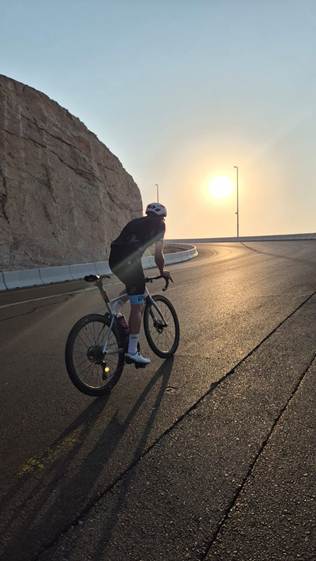
JEBEL HAFEET
“EVERESTING” CHALLENGE
JEBEL HAFEET, AL AIN, UNITED ARAB EMIRATES
DATE: 30 September 2026
On 30 September 2026, South African endurance cyclist Warryn Fayard set out at midnight to repeatedly climb the Jebel Hafeet mountain road above Al Ain in the United Arab Emirates. His purpose was not to pursue a record at any cost. It was to complete the demanding Everesting challenge—accumulating at least 8,848 metres of climbing in a single continuous activity—and, in doing so, support charitable causes close to his heart in South Africa.
Everesting is an extreme endurance challenge in which a cyclist repeatedly ascends and descends the same climb in a single activity until accumulating at least 8,848 metres (29,029 feet) of elevation gain—the height of Mount Everest.
This report follows the preparation, family support, fear and determination behind this challenge. It draws principally on Warryn’s first-person recollection, the photographs and activity screenshot supplied to the compiler, and the team’s original planning notes. It also recognises the charities and sponsors whose support gave the effort a wider purpose.
Warryn, aged 34, is a South African endurance cyclist and runner who finds both fitness and respite from Johannesburg’s bustle in long hours on his bicycle in the Cradle of Humankind area. Five- and six-hour solo rides are familiar territory, although they can demand considerable mental resolve. Following two serious knee injuries and major operations some years ago, he remains especially grateful to be able to train and compete. He has completed numerous substantial solo rides around South Africa, holds a racing licence and enjoys competing in veteran cycling groups. Sport has been part of his life since his school days, both competitively and recreationally. Above all, he values training for its fitness benefits, mental clarity and sense of gratitude.
That experience provided an endurance foundation, but not a guarantee. Jebel Hafeet demanded repeated climbing, disciplined descending, regular refuelling and the capacity to continue when both body and mind were depleted.
“I love spending many long hours on my bicycle out in The Cradle of Human Kind just staying fit and using it as an escape from the hustle and bustle of Johannesburg.”
The Everesting objective was straightforward to state and exceptionally difficult to execute: repeat the same ascent until the recorded cumulative elevation gain reaches at least 8,848 metres.
Warryn’s priority was safe completion and charitable fundraising, not an attempt to set a new record.
Each team member was responsible for their own travelling and incidental expenses.
The following sponsors and supporters helped make the challenge possible while supporting fundraising for causes close to Warryn’s heart.
The Sponsors and Beneficiaries were the following:
SPONSORS
The Director of the GLD Shop in Miami, Florida, happens to be Tyrone Fayard, and the company therefore very kindly agreed to be the Lead Sponsor for this project in support of Warryn’s nominated charitable causes

Crank Masters in Al Ain kindly agreed to make available a professional POLYGON Bicycle fitted with full electric gears and disc brake systems which proved to be invaluable during the challenge. The bicycle weighed only 7kg.

Jarryd Fayard and Family kindly arranged the land arrangements, transport, accommodation, bicycle sponsorship, etc. Jarryd owns Fayard Fitness, a very successful Gym and Personal Trainer.
Warryn Fayard has been a regular product sponsored user of CELLFOOD® and CELLFOOD® Sport , incorporating both into his nutritional and training routine. He believes these supplements have contributed positively to his endurance, recovery and overall cycling performance.

BENEFITTING CHARITIES

The SPCA
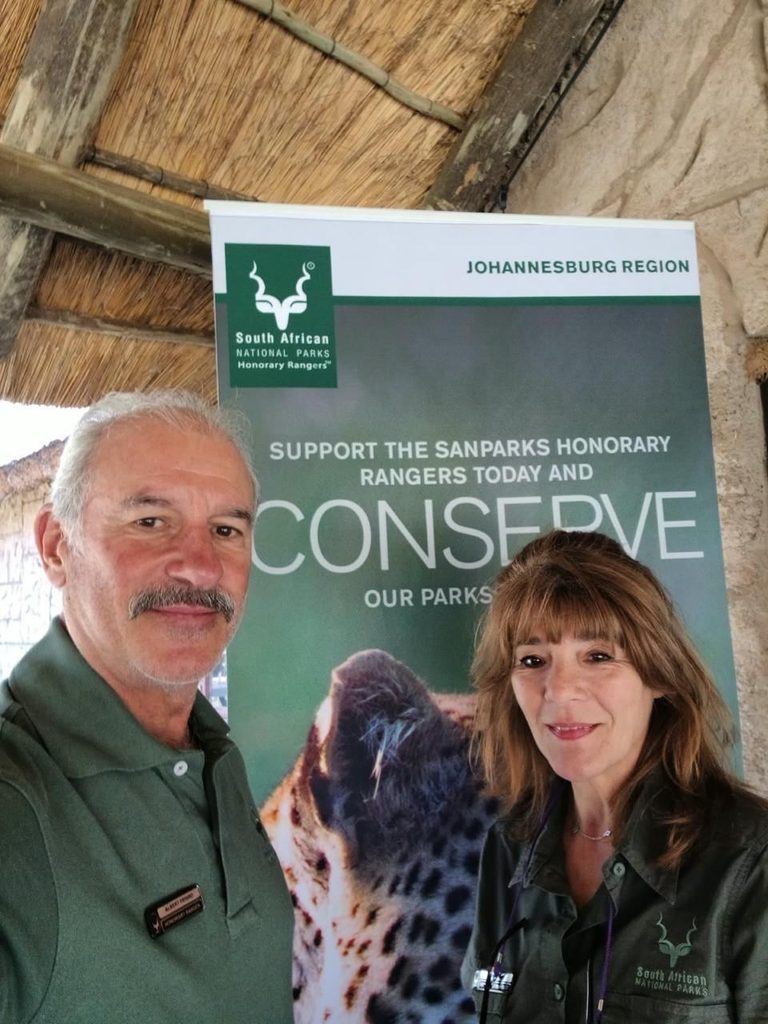
The SANParks Honorary Rangers
Dr Dave Watson’s Transkei Animal Health and Welfare Initiative.
Albert and Filia Fayard, Warryn’s uncle and aunt, ictured with SANParks Honorary Rangers material a personal family connection to one beneficiary.
Dave and his wife Julia are Vets at TAWI
(The Animal Welfare Initiative), where they perform sterilization campaigns, vaccination drives, and educational workshops for Rural communities in Port Edward,
KwaZulu-Natal.
The invitation came in March 2026. It combined three opportunities for Warryn: a demanding personal challenge, a visit to relatives living in Al Ain and a way to raise money for charities back home.
Warryn and his father George arrived in Dubai on 26 September, where his older brother Jarryd collected them. His younger brother Tyrone subsequently joined them, bringing the immediate family team together.
Jarryd, who runs a fitness academy in Al Ain, took the lead in making the local arrangements. He drew on relationships within the Al Ain community, arranged accommodation and set up a reliable base for meals and preparation, and organised the bicycle support. Crank Masters Al Ain supplied a bicycle and arranged its fitting, allowing Warryn to concentrate on the riding rather than the uncertainty of travelling with equipment.
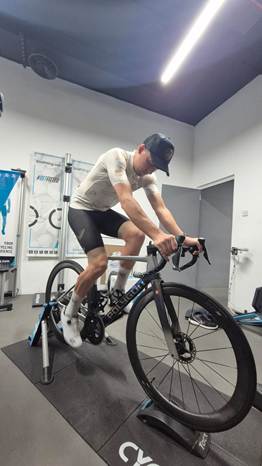
Bicycle collection and fitting at Crank Masters Al Ain.
Due to the high recorded temperatures in Al Ain, September is an unusually punishing time to attempt this ride.
Warryn reported temperatures around 45°C on the preceding day and said locals were surprised that the challenge was being undertaken then; the cooler January period would generally have offered more favourable conditions. The family decided on a midnight start to avoid as much daytime heat as possible.
The planning also called for a support point on the mountain with food, drinks, ice and mechanical essentials, together with access to facilities when needed. These were more than conveniences: repeated climbing in the desert required a dependable place to refuel, recover briefly and assess whether it remained safe to continue.
From South Africa, John Verhoog (“Dutch”) coordinated the reporting requirements, liaising with the team to gather photographs, updates and final statistics.
This editorial coordination was separate from the on-site work carried out by the Fayard family.
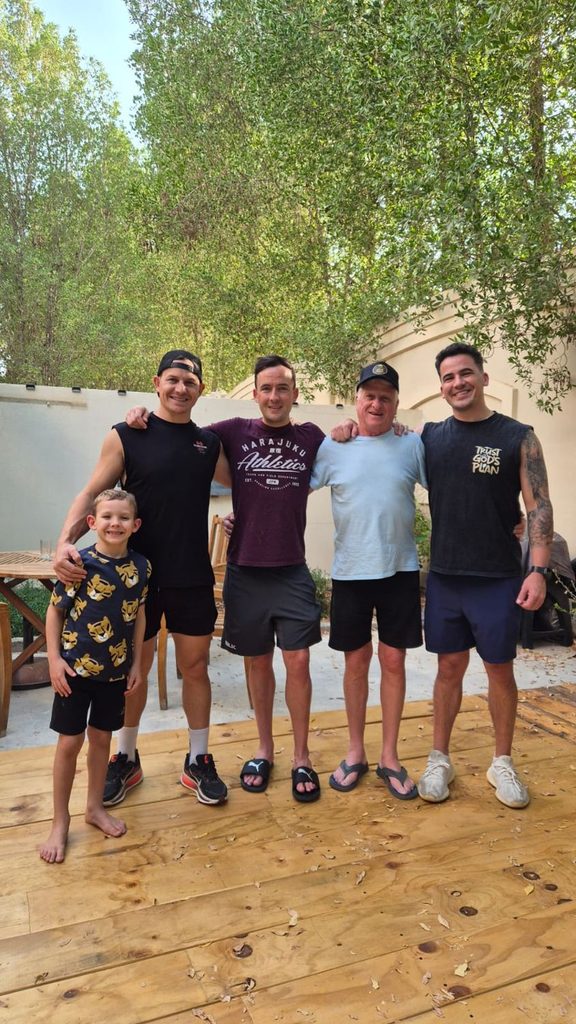
The event was a family effort. George, Warryn’s father, accompanied him from South Africa and provided
practical support at the mountain. Jarryd arranged much
of the local logistics, equipment and refreshments. Tyrone joined the team and assisted with the effort and arranged the main sponsor. Their individual contributions were not always formal or predictable; the challenge demanded that they
adapt as the hours unfolded. Behind the casual photograph were the small, indispensable tasks of ensuring the rider
had a bicycle, ice, food, fluids, transport and people he
could count on when the climbs became difficult.
Warryn had expected the challenge to be formidable, but the conditions made it more intimidating as the start approached. Standing briefly in a car park in roughly 45°C heat brought home the reality of riding for hour after hour in the desert. He had trained to endure long days on a bicycle; he had not trained away the uncertainty of doing it in these conditions.
The day before an endurance event is usually a time to rest, hydrate and prepare mentally. Warryn tried three times to nap, without success. By late evening his body wanted sleep. Instead of brushing his teeth and going to bed, he found himself pulling on his cycling kit, yawning, and preparing for the longest and most demanding ride of his life.
Warryn said: “I started to realise the enormity of the task I had undertaken.”
There was no bravado in his recollection. The family was nervous, and Warryn understood that his familiar ability to ride hard for several hours might not be enough on its own. The plan was to begin at 00:00 on Wednesday, 30 September 2026, UAE time, midnight.
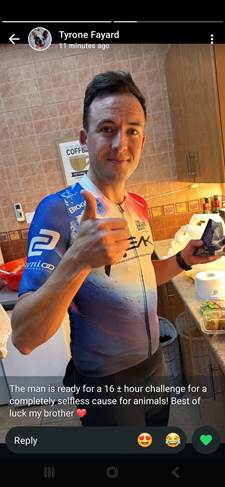
Final preparations at approximately 11 pm, shortly before the midnight start.
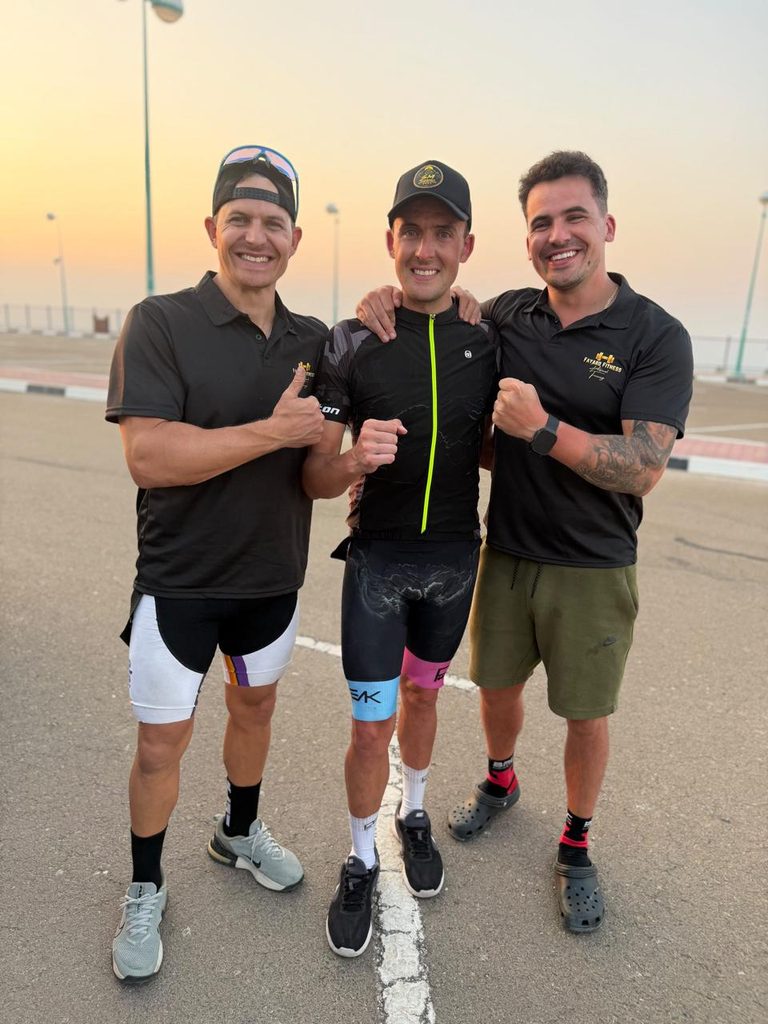
The matching Summit Mission shirts and caps captured the team’s solidarity before the ride. Behind the formal photograph were the small, indispensable tasks of ensuring the rider had a bicycle, ice, food, fluids, transport and people he could count on when the climbs became difficult.
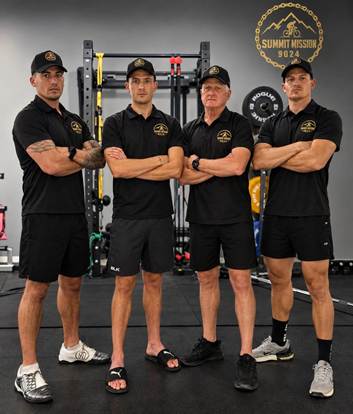
The Fayard team, left to right: Tyrone, Warryn, George (father) and Jarryd Fayard.
The four Fayard’s drove up Jebel Hafeet in darkness. Warryn remembers the journey as quiet and tense: there was little conversation because everyone understood the size of what lay ahead. They established their base in one of the car parks along the roughly nine-kilometre mountain road, laying out drinks, food, mechanical supplies and plenty of ice.
The send-off was almost understated. There was no dramatic countdown. George, Jarryd and Tyrone wished Warryn well, and he rode away alone into the illuminated mountain road.
The silence of that departure remained with him. For all his experience of solo riding, he was immediately struck by an unfamiliar sense of loneliness.
“My brothers and dad just wished me well, and off I went.
Into the dark, on my own in total silence.”
The first three summits went reasonably well, but none was easy. Warryn’s legs began to feel the accumulated fatigue surprisingly early. The missing sleep and persistent overnight heat compounded the effort, and the repeated descents presented a danger different from the climbs themselves.
Warryn recalled yawning heavily while descending at speeds approaching 80 km/h. The road was well lit, but he recognised the kind of drowsiness that can overwhelm a driver at the wheel.
He had to force himself to concentrate. In his account, this was among the most concerning parts of the entire undertaking.
Sunrise provided a small psychological lift, but not a release from the physical demands. By the time he had ridden for approximately five hours, the realisation that many more hours remained, was crushing.
Heat, cramps and mounting exhaustion turned a demanding challenge into an increasingly personal contest with doubt.
“Having done five hours of riding and realising I probably have another ten hours of riding to still do absolutely knocked me.”
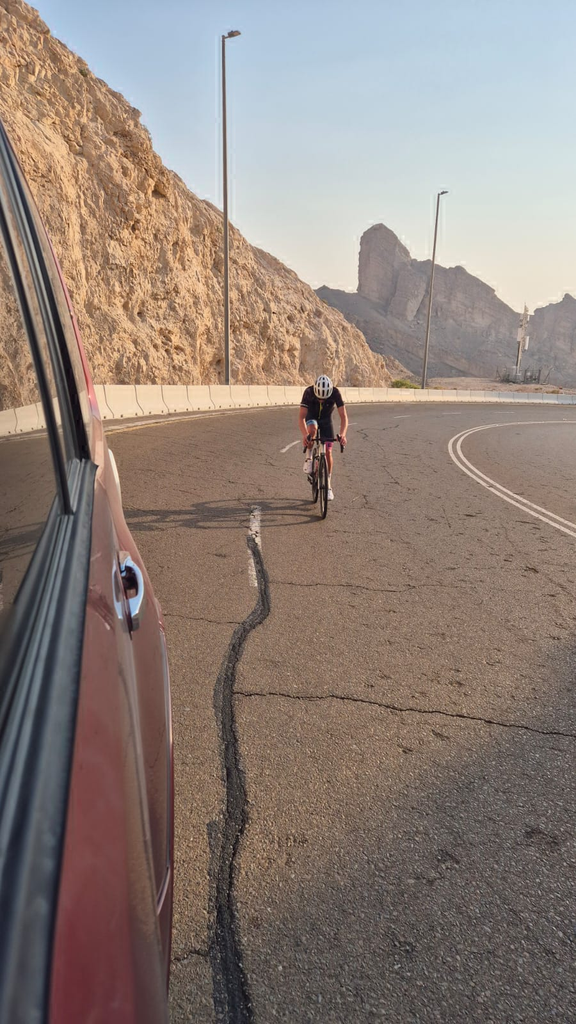
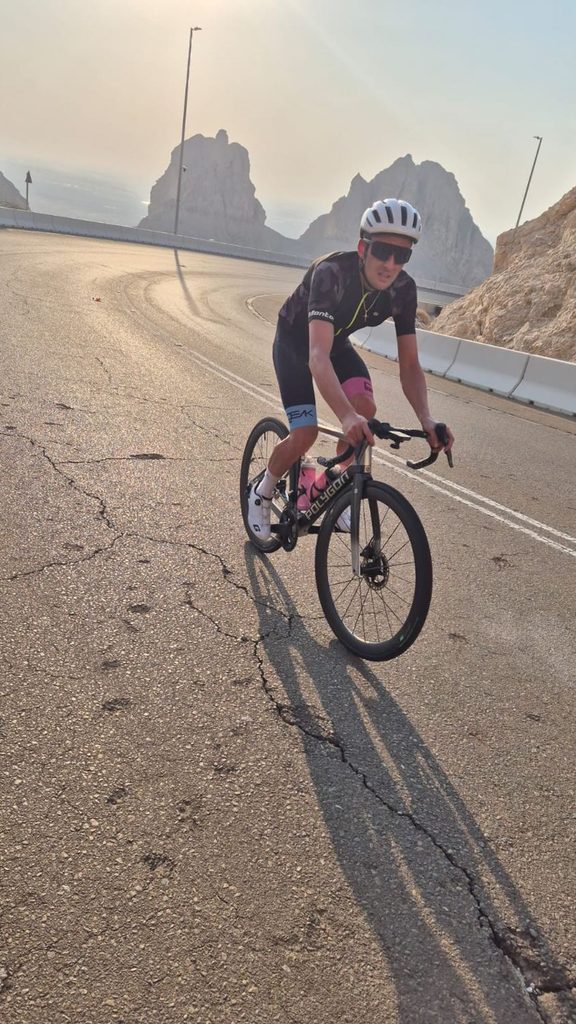
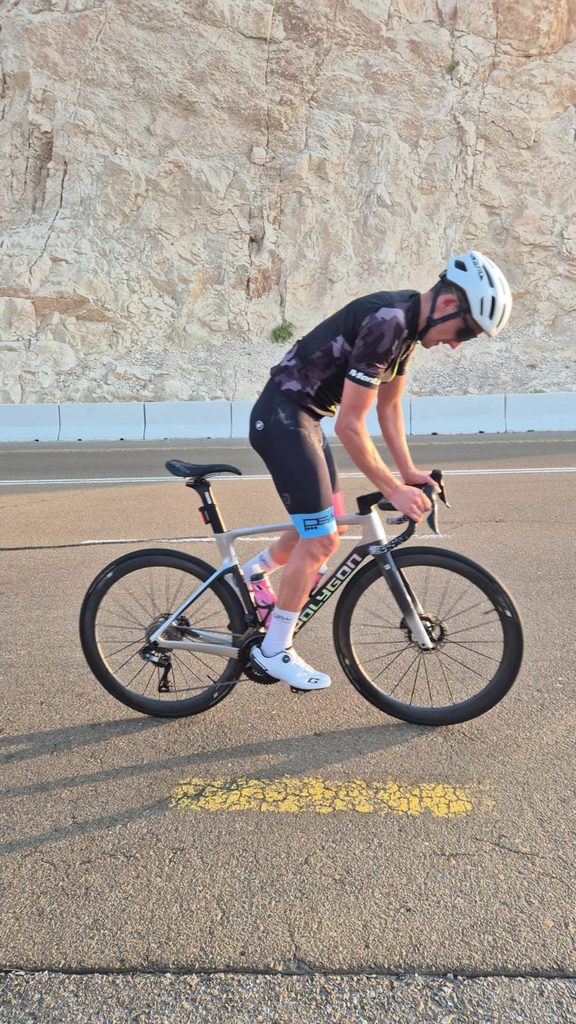
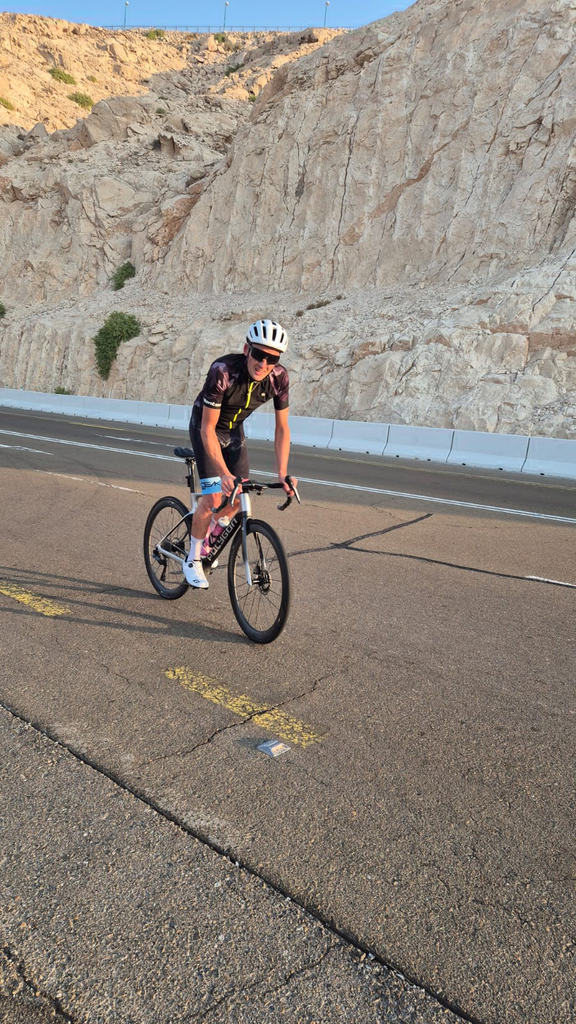
Warryn in action on the Jebel Hafeet mountain road.
“ONWARDS AND UPWARDS”
The support point was an essential link between the climbs. Each return offered an opportunity to replenish supplies and continue. Warryn describes refuelling repeatedly before heading back onto the mountain, even when the finish felt impossibly far away. The family had provided ice, liquids, food and mechanical essentials at their mountain base.
Warryn estimates that he consumed approximately 35 litres of liquid during the effort. His food included sandwiches—earlier information specified four—along with wine gums, cereal bars, milkshakes, biltong and muffins. The quantities, other than his estimate of total liquid, were not recorded as a complete nutrition log.
The original plan allowed longer breaks for bathroom use, bottle refilling and proper meals after selected repeats, but the precise number and duration of stops have not been documented. The report therefore does not invent a stop-by-stop timetable. The meaningful point is the continuous cycle of climbing, descending, refuelling and returning to the road.
Around the fifth summit, Warryn began to doubt that he could finish. He was tired, cramped and overwhelmed by the heat. He has spoken candidly of hoping for a reason to stop. Yet each time he returned to the support point, he ate or drank and set out again. His focus gradually shifted away from how much he was enjoying the ride—he was not enjoying it—and towards whether he could simply continue.
On the eighth lap, both brothers joined him on their bicycles for a climb. Their presence helped distract him from the discomfort and reminded him that the effort was shared, even though only he could complete the physical task. Early in the ninth attempt, with more than ten hours of riding behind him, Warryn reached what he describes as the wall.
He considered how he might explain stopping, but could find no clear physical warning sign that made withdrawal inevitable. His heart rate seemed normal to him, although this was a personal assessment rather than a medical evaluation. He made a mental decision to persevere, one climb at a time.
“That is when it clicked, it is time to go mental, dig deep, go to the dark place that everyone has to face at some point in life and just carry on.”
He began to see the tenth summit as a decisive threshold. If he could get there, he believed he would somehow find a way through the remainder. His clothing and skin were caked with salt from sweat. He was exhausted both physically and mentally, yet he found a second wind and pushed through the final climbs. He later marvelled that he could increase his effort even in such a depleted state.
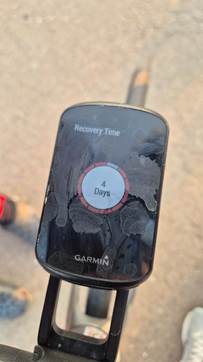
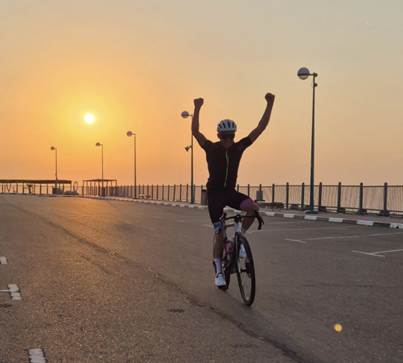
A sustained effort against heat, fatigue and the steep mountain road.
See the sweat on the Garmin…
The final arrival was an immense relief. Warryn had completed the Everesting requirement and had gone well beyond it. His recorded elevation gain was 9,587 metres, 739 metres more than the 8,848-metre target. He travelled 268.29 kilometres, with a Strava riding time of 14 hours 28 minutes.
An earlier team update gave a total elapsed time of 17 hours 4 minutes. Because riding or moving time and elapsed time measure different things, that elapsed figure is retained as provisional until the full activity record confirms it. Warryn reports that his overall elapsed time was the third-fastest and his riding time the second-fastest for Jebel Hafeet; the report treats these as his reported rankings pending official verification.
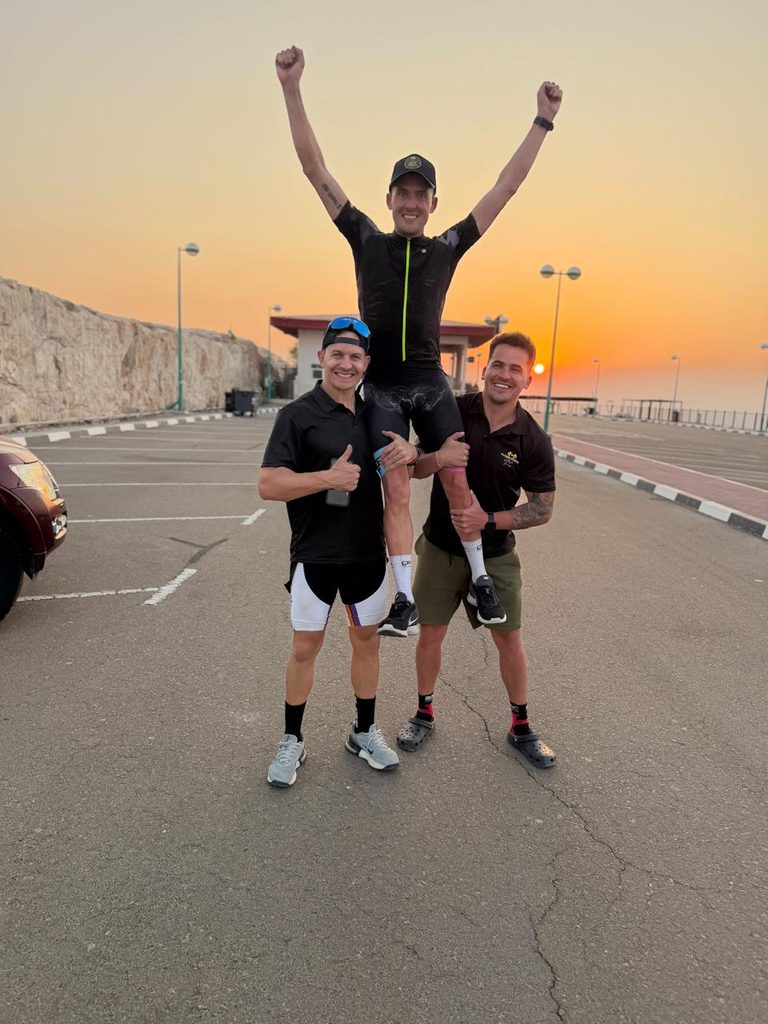
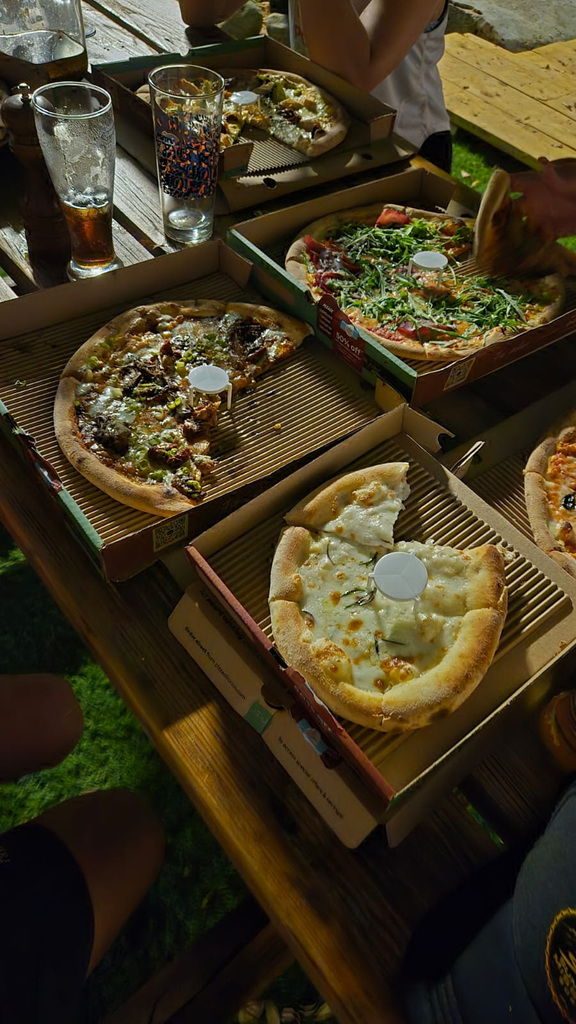
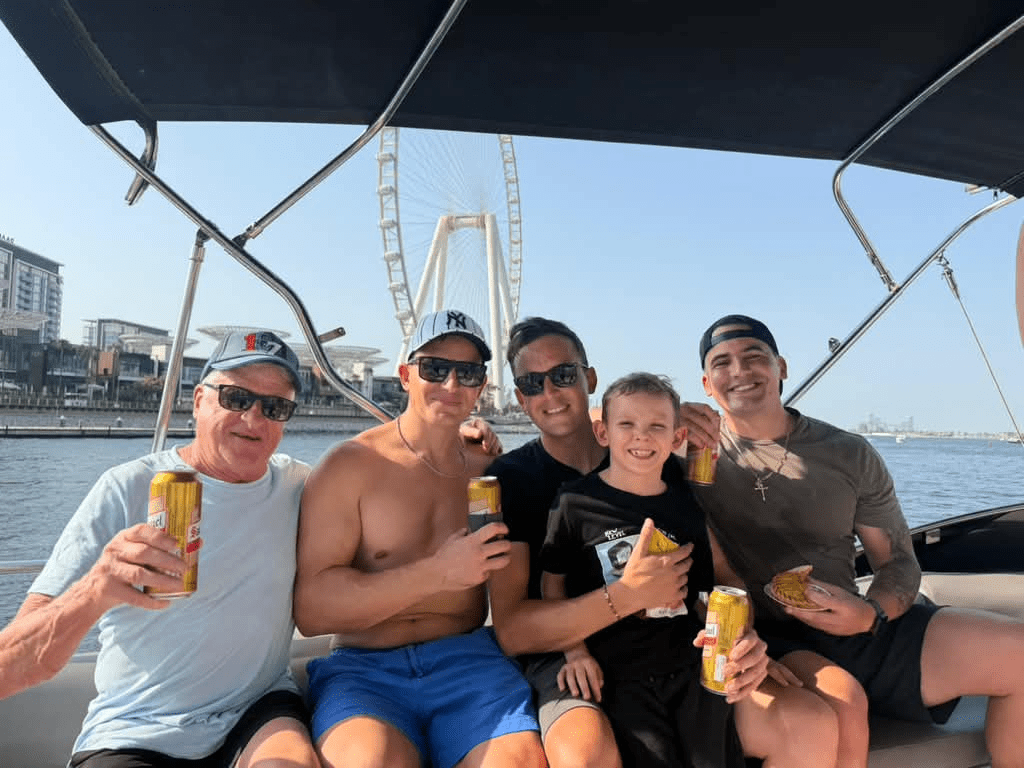
Later that evening, Cara and the family welcomed the party home, where they shared pizza and beer and recalled the events of the day, including the moments when success had seemed far from certain.
For Warryn, the meal was more than a celebration of distance and elevation. It marked the end of an ordeal and the achievement of a charitable goal that had drawn the family together.
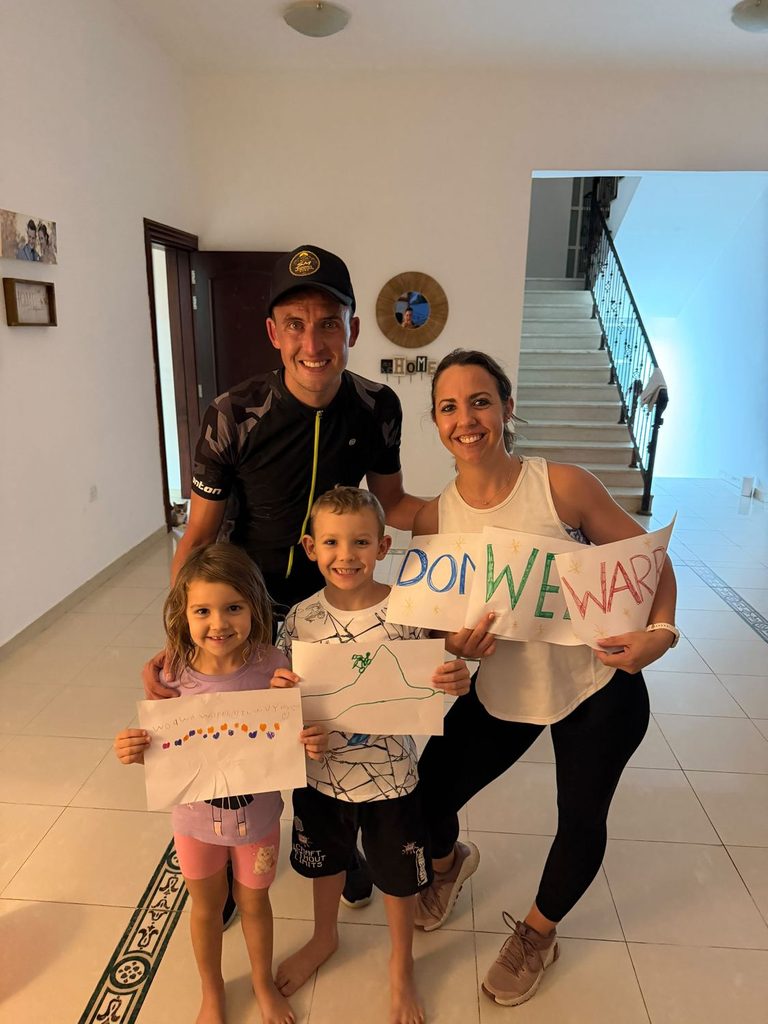
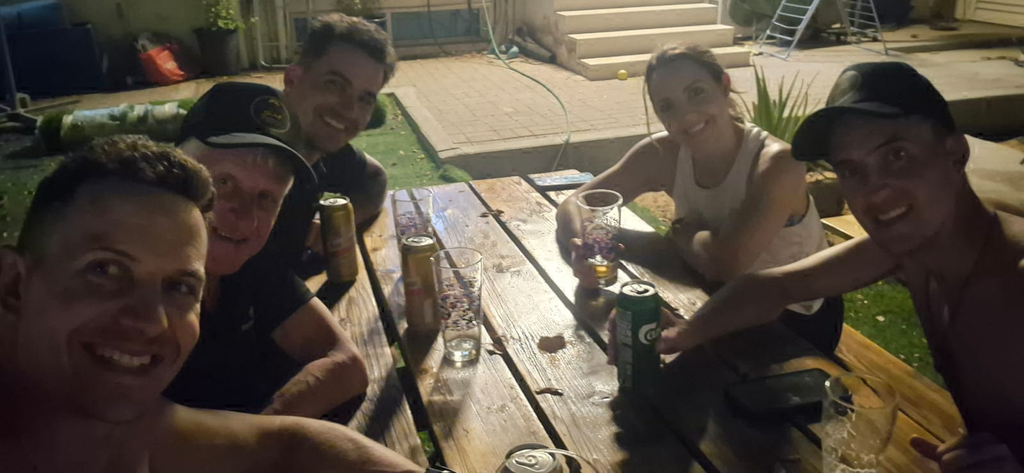
Cara, Kai and Ayla formed a WELCOME HOME Party.
Warryn’s Strava summary shows 268.29 km travelled, 9,587 m of elevation gain and 14 hours 28 minutes of riding time. The previously reported overall elapsed time was approximately 17 hours 4 minutes; that figure requires confirmation from the full activity record.
Warryn has described the ride as his hardest sustained mental and physical test, aggravated by September heat and a night without sleep.
| Date | 30 September 2026 (UAE local time) |
| Elevation gain | 9,587 m |
| Everesting threshold | 8,848 m |
| Excess elevation | 739 m |
| Distance | 268.29 km |
| Riding time shown on screenshot | 14 h 28 min |
| Overall elapsed time | Approximately 17 h 04 min — confirmation pending |
| Calories | Approximately 10,000 — Warryn’s estimate |
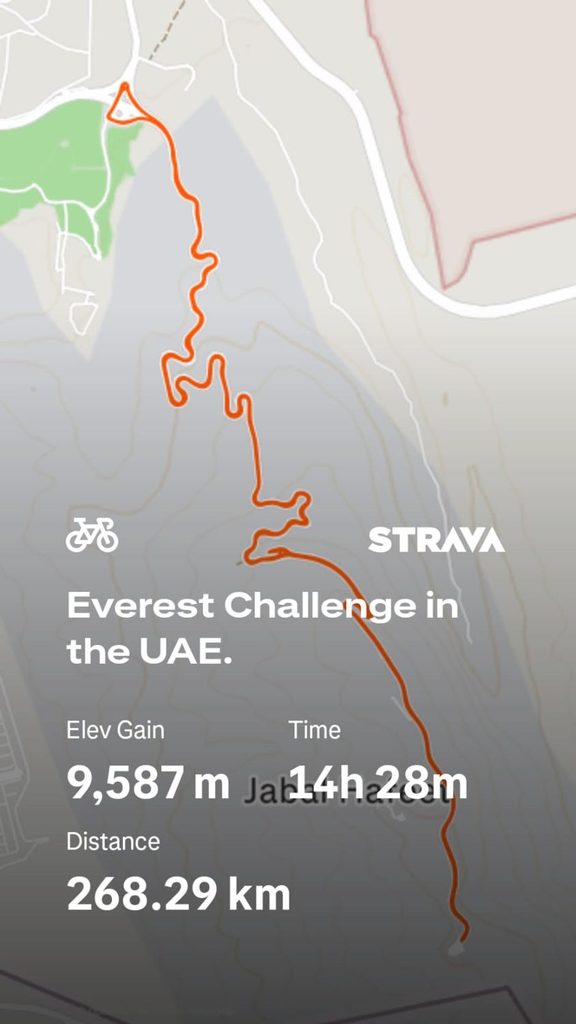
Strava route and activity summary supplied by Warryn. The image shows riding time, distance and elevation gain.
Warryn’s account is distinguished by gratitude as much as by the suffering he describes. He speaks of being grateful for the health and opportunity to undertake such an effort, and of a habit of crossing himself after exercise in recognition of that blessing. Completing Jebel Hafeet reaffirmed his belief that people can discover reserves of inner strength when they need it most.
The challenge also meant something beyond personal endurance. It brought together a father and three sons in Al Ain, drew on the generosity of local supporters and secured charitable support for causes linked to animals, conservation and South African communities. Warryn was emphatic in thanking organisers and donors for making it possible.
“I have never had to dig that deep for that long … I am just reminded of inner strength we all have when needed.”
His message to the people who helped was simple and heartfelt:
“Thank you, thank you, thank you.”
My son Warryn took on the incredible Everest Challenge, cycling up Jebel Hafeet in the UAE. It was a tough and demanding challenge, requiring determination, strength and perseverance, but he never gave up and successfully completed the task.
Myself and my other two sons were there to support and encourage him throughout this achievement. Watching him push through the difficulties and reach his goal filled me with immense pride as a father. His brothers were equally happy and proud to see him succeed.
It was a special and memorable experience for our family. His achievement showed the importance of determination, courage and never giving up, even when things get difficult.
Well done, son! We are all incredibly proud of you.
George Fayard
12 October 2026
The official Everesting Hall of Fame submission and acceptance status have not yet been confirmed in the materials provided. The Strava screenshot documents the ride figures, but the report should not imply that official verification has already taken place. Once confirmation is supplied, the status and any validated rankings can be updated here.
No future event has been assumed. If Warryn wishes, this section may briefly discuss what he hopes to do next, whether another endurance ride, continued charitable activity or simply a return to cycling for enjoyment.
The story may be suitable for consideration by South African sports and human-interest media, including Carte Blanche: a family-supported endurance challenge in extreme desert conditions, undertaken for charity, with compelling first-person testimony and extensive photography.
A Note from the Compiler
It has been a privilege to compile this account of Warryn Fayard’s Jebel Hafeet Everesting Challenge. What began as an extraordinary test of endurance became an inspiring story of determination, family support and generosity towards worthwhile South African causes.
My thanks go to Warryn, George, Jarryd, Tyrone and everyone who contributed their recollections, photographs and support.
I hope this report preserves not only the achievement, but also the spirit in which it was undertaken.
DUTCH
16 October 2026
Athlete and principal account: Warryn Fayard.
On-site family support: George Fayard, Jarryd Fayard and Tyrone Fayard.
Bicycle sponsor and fitting: Crank Masters Al Ain.
Charitable donation sponsor: The GLD Shop, Miami.
Charitable beneficiaries:
The following details remain unconfirmed at the time of this edition:
• Official Everesting Hall of Fame acceptance and any independently validated rankings.
• Total elapsed time, provisionally reported as approximately 17 h 04 min.
Individual lap times and cycling power data are intentionally omitted. Estimated calories, temperature and fluid consumption are attributed to Warryn’s account rather than presented as independently verified measurements.
Editorial choices: The report deliberately excludes individual lap times and cycling Power data. It does not present estimated calories, temperatures, liquids or rankings as independently verified measurements. The original activity image is included for readers to inspect directly.