|
|
Who is he? • Associate Professor of Pathology College of Physicians • Professor of Medicine Capital University of Integrative Medicine • Editor of The Journal of Integrative Medicine |
His Story
For forty-six years, I have studied cancer – as a student of medicine,
as a surgeon, as a pathologist, as an immunologist, as a clinician
preoccupied with oxygen equilibrium in the body; and, finally, as
an integrative physician deeply interested in the spiritual dynamics
of healing. Most importantly, I have striven to see and investigate
the problem of cancer through the eyes of my patients.
As a young pathologist, I learned that one does not talk about restoring
an immune system damaged by chemotherapy in hospital oncology conferences.
That is where ‘men’ are separated from ‘boys’. ‘Men” do
not engage in taboo subjects of ‘building up the immune system’ with
chicanery of nutrient therapies and herbal concoctions. I do not
recall if ever the word healing was spoken in thousands of those
conferences. That was a word of the ‘fringe medicine’.
Real men of medicine were to remain above that.
All that changed when I began my work with integrative medicine
and started to look at cancer through the eyes of my patients.
Energetics of a Healthy Cell and a Cancer Cell
The crucial difference between the energetics of a healthy cell
and a cancer cell is:
– A healthy cell uses oxygen for energy.
– A cancer cell shuns oxygen and ferments sugar instead for its energy requirements.
Remember that for cellular energy production, when a glucose molecule is broken
down by oxygen, it produces 36 molecules of ATP; whereas when a glucose molecule
ferments (without oxygen), it only produces 2 molecules of ATP.
This would explain why many cancer patients lack energy.
The State of Oxygen in the Body
Any element that threatens the oxygen order of the human body will
promote cancer growth. Any therapy that improves the oxygen function
can be expected to enhance the body’s defences against cancer.
That is borne out by clinical experience.
Except when an early cancer can be removed completely with surgery, the state
of the oxygen in the body – not chemotherapy or radiotherapy – determines the
long-term health and quality of life of the patient.
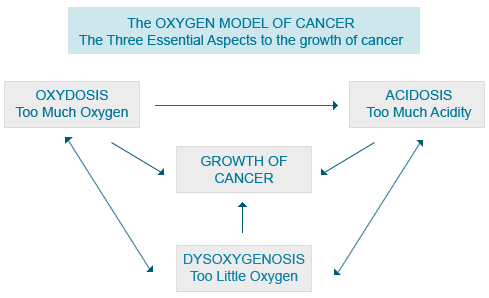
The strength of any model rests on two fundamental
aspects: First, it explains what is observed. Second, things get
done better with it. For a medical model to be valid, it should
have a strong explanatory power for clinical findings, and it should
provide logical basis for formulating treatment plans that may be
proven safe and effective with long-term, true-to-life clinical
outcome studies.
Oxygen Homeostasis
The Oxygen Model is about restoring oxygen homeostasis and not
merely about dumping oxygen into the body, by mask, hydrogen peroxide
foot soaks, intravenous infusion of ozone, hyperbaric oxygen, etc.,
though all of those therapies greatly help.
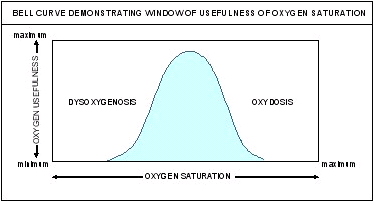
The Oxygen Model
The Oxygen Model is about understanding the “oxygen conditions” that
preserve health and those that set the stage of the development
and spread of cancer.
The oxygen conditions, for instance, are profoundly influenced
by the spiritual equilibrium in one’s life, or absence of
it. For example: Anger is dysoxygenative, it causes oxygen dysequilibrium.
Demands for consideration, understanding, or love are also dysoxygenative.
Elements in diets, e.g. sugar, rob people of oxygen.
Pantotropha (Thiosphaera pantotropha)
In nature, there are cells that love oxygen. I call them oxyphiles.
There are cells that have a phobia against oxygen, and so I call
them oxyphobes. There are other families of cells that are metabolic
two-timers because they readily change their “oxygen-preference” when
their environmental conditions change. These are called pantotropha
(Thiosphaera pantotropha).
First identified in 1983 in sewerage plants, this microbe can energize
itself with sulfur and nitrogen compounds in the absence of oxygen.
When oxygen is available, it switches to an oxygen-driven metabolism
mode and efficiently extracts energy from a wide arrange of inorganic
substances by aerobic respiration.
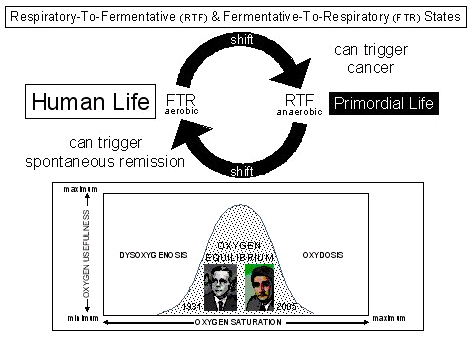
I see strong clinical evidence that the cancer cell is pantotrophic;
and, under certain conditions, abandons its oxygen-hating behaviour
and joins the community of peaceful cells with an aerobic physiologic
mode of metabolism.
With oxygen treatment, many patients with prostate cancer or chronic
lymphocytic leukemia, have been assisted to create microecological
conditions whereby the cancer cells have turned from an anaerobic
microbe-like fermentative mode of ATP production to an aerobic physiologic
respiratory mode of ATP production.
The phenomenon of “spontaneous remission” substantiates
that cancer cells can be “coaxed” into the fermentative-to-respiratory
(FTR) shift, and remain faithful to the normal metabolism of oxygen
respiratory ATP production.
Six Principal Characteristics of a Cancer Cell
1. Respiratory-to-fermentative (RTF) shift in ATP production;
2. Production of prodigious quantities of organic acids – lactic
acid and others;
3. Creation of a cocoon of coagulated proteins around malignant
cells to exclude functioning host immune
cells and their soluble
defense molecules (pathogenic fibrin);
4. Uncontrolled cellular replication that disrupts local tissue
architecture (tumours, growths);
5. Colonization of distant tissues in which destructive behaviour
of neoplastic cells continues (metastases);
6. Under certain conditions, a cancer cell can be coaxed to alter
its behaviour (FTR shift).
(Majid Ali versus Otto Warburg)
Majid Ali versus Otto Warburg
Dr Otto Warburg (Nobel Laureate 1931 & 1944) reported:
 |
“The primary cause of cancer is the replacement of normal respiration of body cells by anaerobic cell respiration.” |
“The respiratory-to-fermentation (RTF) shift is irreversible.”
Dr Majid Ali (2000):
 |
“The respiratory-to-fermentation (RTF) shift, under certain oxygen conditions, IS reversible – the FTR shift.”
|
Dr Otto Warburg (Lecture to Nobel Laureates 1969):
“Cancer can be prevented by:
1) increasing blood circulation;
2) ensuring there is a high concentration of haemoglobin in the blood; and
3) supplying the respiratory enzymes with oxygen to enable respiratory oxidation in the mitochondria.”
“It is tragic that many people have died unnecessarily from
cancer, and they may, unfortunately, continue to die from cancer
because insufficient attention is being paid to important research,
and to the importance of oxygen in the body.”
Dr Majid Ali (2000): Totally agreed with Otto Warburg, and based
his research on the possibility of the FTR shift on 3).
Cancer Cells war against Healthy Cells
A subject that is seldom, if ever, addressed is how cancer cells
damage healthy cells in their vicinity and cause an oxygen shift
in them – turning oxyphiles into oxyphobes, further spreading the
dangerous chemistry of deranged oxygen metabolism.
1. Cancer cells smear the surfaces of healthy cells with their
toxic acids, so blocking their membrane
channels, receptors, and
pumps.
2. Cancer cells clot proteins in the fluids that bathe healthy
cells, and so rob them of their nourishment. The
process of protein
clotting also reduces blood and lymph flow in healthy tissues, so
devitalizing them.
3. Cancer cells cause mutations in the genes of healthy cells.
This cumulative onslaught results in the suffocating deoxygenation
and terminal starvation of healthy cells.
Chemotherapy
The main reason Chemotherapy has a dismal record is that it does
not address any of the critical issues of deranged oxygen order
in cancer cells.
Chemotherapy wreaks havoc on the various aspects of the oxygen
order in healthy cells. It does work well in most childhood cancers
because, in my view, children have an enormous capacity to withstand
severe punishment to the oxygen order.
Chemotherapy drugs significantly contribute in many ways to oxidosis
(too much oxidative stress), acidosis (too much acidity), and dysoxygenosis
(oxygen dysfunction). It is for that reason that nearly all cancers
become much more aggressive and grow rapidly if they return following
Chemotherapy. Chemo drugs do not brings about the necessary FTR
shift.
CHANGING PROSTATE SPECIFIC ANTIGEN (PSA) VALUES WITH AIR TRAVEL
(PSA is a marker for prostate cancer)
Air travel stresses oxygen in many ways, resulting in patterns
of ill health associated with long flights – air travel dysoxygenosis.
CASE STUDY EXAMPLE
65 year old male with prostate cancer
traveled from USA to Europe for 2-3 week holidays
|
Date
|
PSA Values Before Trips
|
PSA Values After Trips
|
Treatment
|
|
1995
|
12,2
|
22,0
|
(1)
|
|
1996
|
7.9
|
23.2
|
(1)
|
|
1997
|
21.1
|
25.3
|
(2)
|
|
1998
|
23.5
|
32.2
|
(3)
|
|
1998
|
3.6
|
11.1
|
(3)
|
|
1999
|
2.5
|
3.1
|
(3)
|
|
1999
|
2.2
|
6.6
|
(3)
|
|
2000
|
1,1
|
3,3
|
(3)
|
(1) On Phytohormones
(2) On Zoladex and Casadex
(3) On PC SPESS
After each trip, his PSA Value returned to previous
level within 2 months.
Concluding Comments
I see hope in newer drugs that restore normal oxygen-driven cellular communications. I recognize much potential in the clinical benefits of antibodies directed against signaling molecules that sustain and perpetuate malignant cell replication, e.g. agents such as Gleevec, Iressa, Herceptin, Rituxin, Avastin. But there is something far more important of interest here: good old oxygen.
www.majidali.com
091-212-873-2444
Manhattan
091-973-586-4111
New Jersey
Dr Otto Warburg (Nobel Laureate 1931 & 1944) reported:
|
Nobel Prize in Physiology / Medicine 1931 “The primary cause of cancer is the replacement of normal Second Nobel Prize in Physiology / Medicine 1944 |
1966 – Lecture delivered to Nobel Laureates:
“The Prime Cause and Prevention of Cancer”
“ When respiration disappears, life does not disappear, but the meaning
of life disappears, and what remains are growing machines that destroy the
body in which they grow.”
Dr Otto Warburg, M.D., “The Oxygen-transferring Ferment of Respiration”,
Lecture at Nobel Prize Award, 10 Dec 1931.
Dr Otto Warburg, M.D., “The Prime Cause and Prevention of Cancer”,
Lecture to Nobel Laureates at Lindau Germany, 30 Jun 1966.
Dr Arthur C Guyton
Dr. Arthur C. Guyton, author of “The Textbook of Medical Physiology”,
writes:
“ All chronic pain, suffering and diseases are caused from a lack of oxygen at
the cell levels.”
Dr. Arthur C. Guyton, M.D. & Dr. John E. Hall, Ph.D., “Textbook
of Medical Physiology”, 10th Edition, W.B. Saunders Company, Philadelphia,
Pennsylvania, 2000.
Dr Stephen Levine
Dr. Stephen Levine, renowned Molecular Biologist, writes: “In all serious
disease states, we find a concomitant low oxygen state….Low oxygen in
the body tissues is a sure indicator for disease ..…. Hypoxia, or lack
of oxygen in the tissues, is the fundamental cause for all degenerative disease.”
Dr Stephen Levine, “Immunity, cancer, oxygen, and candida albicans”,
and “Oxygen Deficiency: A Concomitant to All Degenerative Illness”,
Let’s Live Magazine, Franklin Publications, CA, Aug 1986.